



$Apostle701
$wipministries2

Make Checks Payable to:
Grace Temple Outreach
Ministries Inc
701 SW Charlie Ave
Micanopy, Fl 32667
(352) 215-8214


Theme: 2026
God Justifieth the Ungodly
This message is for you. You will find the text in the Epistle to the Romans, in the fourth chapter and the fifth verse, “To him that worketh not, but believeth on him that justifieth the ungodly, his faith is counted for righteousness.” I call your attention to those words, “Him that justifieth the ungodly.” They seem to me to be very wonderful words. Are you not surprised that there should be such an expression as that in the Bible, “That justifieth the ungodly?” I have heard that men that hate the doctrines of the cross bring it as a charge against God, that He saves wicked men and receives to Himself the vilest of the vile. See how this Scripture accepts the charge, and plainly states it! By the mouth of His servant Paul, by the inspiration of the Holy Ghost, He takes to Himself the title of “Him that justifieth the ungodly.” He makes those just who are unjust, forgives those who deserve to be punished, and favors those who deserve no favor. You thought, did you not, that salvation was for the good? that God’s grace was for the pure and holy, who are free from sin? It has fallen into your mind that, if you were excellent, then God would reward you; and you have thought that because you are not worthy, therefore there could be no way of your enjoying His favor. You must be somewhat surprised to read a text like this: “Him that justifieth the ungodly.” I do not wonder that you are surprised; for with all my familiarity with the great grace of God, I never cease to wonder at it. It does sound surprising, does it not, that it should be possible for a holy God to justify an unholy man? We, according to the natural legality of our hearts, are always talking about our own goodness and our own worthiness, and we stubbornly hold to it that there must be somewhat in us in order to win the notice of God. Now, God, who sees through all deceptions, knows that there is no goodness whatever in us. He says that “there is none righteous, no not one.” He knows that “all our righteousnesses are as filthy rags,” and, therefore the Lord Jesus did not come into the world to look after goodness and righteousness with him, and to bestow them upon persons who have none of them. He comes, not because we are just, but to make us so: he justifieth the ungodly. When a counsellor comes into court, if he is an honest man, he desires to plead the case of an innocent person and justify him before the court from the things which are falsely laid to his charge. It should be the lawyer’s object to justify the innocent person, and he should not attempt to screen the guilty party. It lies not in man’s right nor in man’s power truly to justify the guilty. This is a miracle reserved for the Lord alone. God, the infinitely just Sovereign, knows that there is not a just man upon earth that doeth good and sinneth not, and therefore, in the infinite sovereignty of His divine nature and in the splendor of His ineffable love, He undertakes the task, not so much of justifying the just as of justifying the ungodly. God has devised ways and means of making the ungodly man to stand justly accepted before Him: He has set up a system by which with perfect justice He can treat the guilty as if he had been all his life free from offense, yea, can treat him as if he were wholly free from sin. He justifieth the ungodly. Jesus Christ came into the world to save sinners. It is a very surprising thing—a thing to be marveled at most of all by those who enjoy it. I know that it is to me even to this day the greatest wonder that I ever heard of, that God should ever justify me. I feel myself to be a lump of unworthiness, a mass of corruption, and a heap of sin, apart from His almighty love. I know by a full assurance that I am justified by faith which is in Christ Jesus, and treated as if I had been perfectly just, and made an heir of God and a joint heir with Christ; and yet by nature I must take my place among the most sinful. I, who am altogether undeserving, am treated as if I had been deserving. I am loved with as much love as if I had always been godly, whereas aforetime I was ungodly. Who can help being astonished at this? Gratitude for such favor stands dressed in robes of wonder. Now, while this is very surprising, I want you to notice how available it makes the gospel to you and to me. If God justifieth the ungodly, then, dear friend, He can justify you. Is not that the very kind of person that you are? If you are unconverted at this moment, it is a very proper description of you; you have lived without God, you have been the reverse of godly; in one word, you have been and are ungodly. Perhaps you have not even attended a place of worship on Sunday, but have lived in disregard of God’s day, and house, and Word—this proves you to have been ungodly. Sadder still, it may be you have even tried to doubt God’s existence, and have gone the length of saying that you did so. You have lived on this fair earth, which is full of the tokens of God’s presence, and all the while you have shut your eyes to the clear evidences of His power and Godhead. You have lived as if there were no God. Indeed, you would have been very pleased if you could have demonstrated to yourself to a certainty that there was no God whatever. Possibly you have lived a great many years in this way, so that you are now pretty well settled in your ways, and yet God is not in any of them. If you were labeled ungodly it would as well describe you as if the sea were to be labeled salt water. Would it not?
Persecutions of the Christians in Persia
The Gospel having spread itself into Persia, the pagan priests, who worshipped the sun, were greatly alarmed, and dreaded the loss of that influence they had hitherto maintained over the people’s minds and properties. Hence they thought it expedient to complain to the emperor that the Christians were enemies to the state, and held a treasonable correspondence with the Romans, the great enemies of Persia. The emperor Sapores, being naturally averse to Christianity, easily believed what was said against the Christians, and gave orders to persecute them in all parts of his empire. On account of this mandate, many eminent persons in the church and state fell martyrs to the ignorance and ferocity of the pagans. Constantine the Great being informed of the persecutions in Persia, wrote a long letter to the Persian monarch, in which he recounts the vengeance that had fallen on persecutors, and the great success that had attended those who had refrained from persecuting the Christians. Speaking of his victories over rival emperors of his own time, he said, “I subdued these solely by faith in Christ; for which God was my helper, who gave me victory in battle, and made me triumph over my enemies. He hath likewise so enlarged to me the bounds of the Roman Empire, that it extends from the Western Ocean almost to the uttermost parts of the East: for this domain I neither offered sacrifices to the ancient deities, nor made use of charm or divination; but only offered up prayers to the Almighty God, and followed the cross of Christ. Rejoiced should I be if the throne of Persia found glory also, by embracing the Christians: that so you with me, and they with you, may enjoy all happiness. In consequence of this appeal, the persecution ended for the time, but it was renewed in later years when another king succeeded to the throne of Persia.
When a Brother Sins Against You
Key Verse: Matthew 18:15 I. Remember That You Are Not Sinless and You Cannot Expect Others to Be A. The word “if “ in Matthew 18:15 is the Greek ἐάν which is a suppositional conjunction of objective possibility. It is a situation likely to occur, not a subjective supposition which may never be realized (usually indicated by the Greek particle εἰ). Don’t live in a dream world thinking that your brother in Christ is so perfect that he will never do anything to offend you.
B. The verb “trespass” in Matthew 18:15 is in the subjunctive aorist (ἁμαρτήσῃ) which indicates not a life of sin, but a single act. It basically means to miss the mark. You set the mark for your brother but somehow he misses it. He does not measure up to your expectations. This happens so easily. We meet our own aim, but often miss the goals others set for us. II. No Indifference Is Allowed in the Life of the Christian Toward Another
A. This does not mean, however, that we have the right to pry into the lives of others in order to find a reason to correct them. Our Lord gave us clear command not to judge others in Matthew 7:1, 2, “Judge not, that ye be not judged. For with what judgment ye judge, ye shall be judged: and with what measure ye mete, it shall be measured to you again.” No one has the right to be a self-appointed judge of others. The commandment, “Judge not,” is in the present indicative entailing continuity of action.
B. Christ teaches in Matthew 18:15 that if you are offended because your brother fails to meet your standard in something particular, you should go to him. This only involves something personal as indicated by the phrase “against thee.” It does not say that you should take up the cause if it is against someone else. It must be something which affects you and you alone.
C. Your brother may be totally unconscious of the thing he has done to disappoint you. If you refuse to see him about it, you may continue to harbor feelings against him, which would be harmful to you. III. The Injured Person Must Go to the One Who Offended A. Let it be a private matter. Instead of telling others, go and reprove him. The verb ἔλεγξον is the aorist imperative active of ἐλέγχω, “to rebuke, reprove.” This indicates a once and for all action. It implies that the brother is in the wrong for whatever he did against his brother. B. The purpose of going to him is to win him. If you do not make him aware of the problem, he will continue sinning to his own detriment. The approach of the injured is redemptive “ … if he shall hear thee, thou hast gained thy brother.” C. The meaning of the verb “hear” (ἀκούω) is “to heed or obey” which proves that the injurious person needs to amend his way. IV. Continuing to Harm a Brother Is Inadmissible in a Church Body A. If the offending person does not heed the reproof of the injured person, he must be given a second opportunity to “shape up” in the presence of other witnesses (Matt. 18:16). B. If this reproof is also rejected it should be brought before the church or the governing body of the church (Matt. 18:17). C. The church is then given authority to deal with such a person as if he were a heathen, and no more a brother. Others must know that he is no longer part of the church and that he has been properly disciplined.

🔥 **Sermon Title: “One Source, One Way”
John 14:6 “Jesus saith unto him, I am the way, the truth, and the life: no man cometh unto the Father, but by me.”*
Introduction:
There’s a generation searching for many sources many voices, many paths, many philosophies — but the Kingdom declares **there is only one Source and one Way!**
We live in a time of spiritual confusion, where people drink from polluted wells and call it revelation. But the Word of God reminds us: there’s only one fountain that never runs dry — the Living Water that flows from Christ Himself!**
Point 1: The Source Defines the Stream**
Every stream carries the DNA of its source.
If the source is pure, the stream will refresh; if the source is corrupted, the stream will poison.
James 3:11* asks, “Doth a fountain send forth at the same place sweet water and bitter?”
You can’t drink from the world and expect holiness to flow out of you.
The Spirit says: **return to the Source — the cross, the blood, the Word!**
Prophetic declaration:* “God is calling His people back to the original flow — not imitation power, not borrowed revelation, but the authentic stream of His Spirit!”
Point 2: The Way Is Narrow, But It’s Sure**
Matthew 7:14* — “Because strait is the gate, and narrow is the way, which leadeth unto life.”
The narrow way isn’t punishment; it’s protection.
The broad way looks easy, but it leads to destruction.
The narrow way demands discipline, holiness, and obedience — but it guarantees destiny.
When you walk the narrow way, you walk in covenant alignment. You stop chasing trends and start chasing truth. You stop following crowds and start following Christ.
Point 3: One Source, One Way, One Glory**
Ephesians 4:4–6* — “There is one body, and one Spirit… one Lord, one faith, one baptism.”
The Kingdom doesn’t operate on multiple systems it flows from one throne.
Every miracle, every revelation, every breakthrough comes from the same Source — Jesus Christ, the Lamb slain before the foundation of the world.**
When you connect to the Source, you don’t need validation from man — heaven itself endorses you.
When you walk in the Way, you don’t need shortcuts — grace carries you through.
Closing Charge**
The Spirit of the Lord says: *“Stop searching for substitutes. Stop mixing streams. Stop chasing voices that don’t echo the Word.”*
There is **one Source — the Father.**
There is **one Way — the Son.**
There is **one Flow — the Holy Ghost.**
Stay connected to the Source, walk in the Way, and you’ll see the Glory!**
This is paragraph text. Double click here to edit and add your own text.
READ GTOMS NEW LETTER
BY
PROPHETESS ANGELIA FRETT
IT'S AWESOME
MAN MUST ALWAYS PRAY.
Luke 18:1 Luke 18:1 And he spake a parable unto them to this end, that men ought always to pray, and not to faint;
Statement of Faith
We believe the Bible to be the inspired, the only infallible, authoritative Word of God. We believe that there is one God, eternally existent in three persons: Father, Son and Holy Spirit.
We believe in the deity of our Lord Jesus Christ, in His virgin birth, in His sinless life, in His miracles, in His vicarious and atoning death through His shed blood, in His bodily resurrection, in His ascension to the right hand of the Father, and in His personal return in power and glory.
We believe that for the salvation of lost and sinful people, regeneration by the Holy Spirit is absolutely essential.
We believe in the present ministry of the Holy Spirit by whose indwelling the Christian is enabled to live a godly life.
We believe in the resurrection of both the saved and the lost; they that are saved unto the resurrection of life and they that are lost unto the resurrection of damnation.
We believe in the spiritual unity of believers in our Lord Jesus Christ.
W.I.P
Pastor Q. Robinson




A weekly Bible Study
EX - CELL U
From the Apostle Desk
Statement of Faith
We believe the Bible to be the inspired, the only infallible, authoritative Word of God. We believe that there is one God, eternally existent in three persons: Father, Son and Holy Spirit.
We believe in the deity of our Lord Jesus Christ, in His virgin birth, in His sinless life, in His miracles, in His vicarious and atoning death through His shed blood, in His bodily resurrection, in His ascension to the right hand of the Father, and in His personal return in power and glory.
We believe that for the salvation of lost and sinful people, regeneration by the Holy Spirit is absolutely essential.
We believe in the present ministry of the Holy Spirit by whose indwelling the Christian is enabled to live a godly life.
We believe in the resurrection of both the saved and the lost; they that are saved unto the resurrection of life and they that are lost unto the resurrection of damnation.
We believe in the spiritual unity of believers in our Lord Jesus Christ.
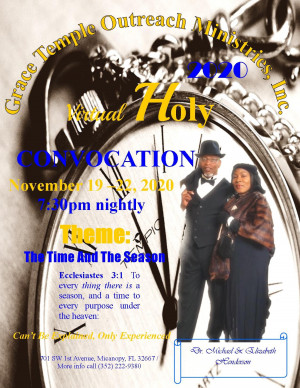
Can't Be Explained Only Experienced
JOIN DR. E. V. HENDERSON
FAEBOOK LIVE 9AM
MONDAY - FRIDAY
Our latest photos
Gospel Play
Quit Trying to Manage What Should Be Trusted
Key Scripture
Proverbs 3:5-6 "Trust in the Lord with all thine heart; and lean not unto thine own understanding. In all thy ways acknowledge him, and he shall direct thy paths."
Introduction
One of the greatest battles believers face is the battle between management and trust. We say we trust God, yet we continuously try to control outcomes, manipulate circumstances, and carry burdens God never assigned to us.
Trust releases God to work. Control keeps us exhausted.
Faith says, "God has it." Fear says, "I better handle it myself."
Every time we try to manage what belongs to God, we exchange peace for pressure.
We Were Never Meant to Carry Everything
Matthew 11:28 "Come unto me, all ye that labour and are heavy laden, and I will give you rest."
Jesus never invited us to carry the burden. He invited us to surrender it.
Many people are:
Managing tomorrow instead of trusting God for it.
Managing people instead of praying for them.
Managing outcomes instead of obeying God.
Managing provision instead of trusting the Provider.
You can be busy and still not be walking in faith.
What Happens When We Try to Manage Everything?
1. We Create Anxiety
Philippians 4:6-7 "Be careful for nothing; but in every thing by prayer and supplication with thanksgiving let your requests be made known unto God."
Anxiety often develops when we assume responsibility for things outside our authority.
Worry is the evidence that we have picked up a burden God told us to give Him.
2. We Exhaust Ourselves
Control is expensive.
When we attempt to manage everyone's response, every circumstance, and every possibility, we become physically, emotionally, and spiritually drained.
God gives grace for obedience, not for control.
3. We Limit God's Work
When Abraham and Sarah tried to manage God's promise, Ishmael was born.
Genesis 16
They attempted to help God fulfill what God had already promised.
Whenever we force what God promised to provide, we create unnecessary complications.
What Should We Trust God With?
Our Future
Jeremiah 29:11
God already knows where He's taking you.
Our Provision
Matthew 6:31-33
Your Father knows what you need before you ask.
Our Family
You can pray for people more effectively than you can control them.
Our Calling
If God called you, God can sustain you.
Our Battles
Exodus 14:14 "The Lord shall fight for you, and ye shall hold your peace."
Some battles are won by surrender, not striving.
Signs You're Managing Instead of Trusting
You constantly worry about what may happen.
You lose peace when circumstances change.
You feel responsible for fixing everyone.
You struggle to rest.
You pray about something and immediately take it back through worry.
If you've prayed about it but still carry it, you haven't released it.
How Do We Move From Control to Trust?
1. Surrender Daily
Trust isn't a one-time event.
It is a daily decision to release your grip.
2. Focus on Obedience
God never asked you to produce results.
He asked you to obey.
3. Replace Worry With Prayer
Every time fear arises, turn it into prayer.
4. Remember God's Track Record
David faced Goliath because he remembered the lion and the bear.
Past faithfulness builds present trust.
Conclusion
The burden is heavy because it was never yours to carry.
God is not asking you to manage the outcome. He's asking you to trust Him with it.
Stop carrying what prayer can handle. Stop forcing what faith can receive. Stop managing what belongs to God.
Final Thought:
"Trust is the proof that you believe God is working, even when you cannot see Him working. The moment you release control, you make room for God to demonstrate His sovereignty."
Memory Verse: Proverbs 3:5 "Trust in the Lord with all thine heart; and lean not unto thine own understanding."